
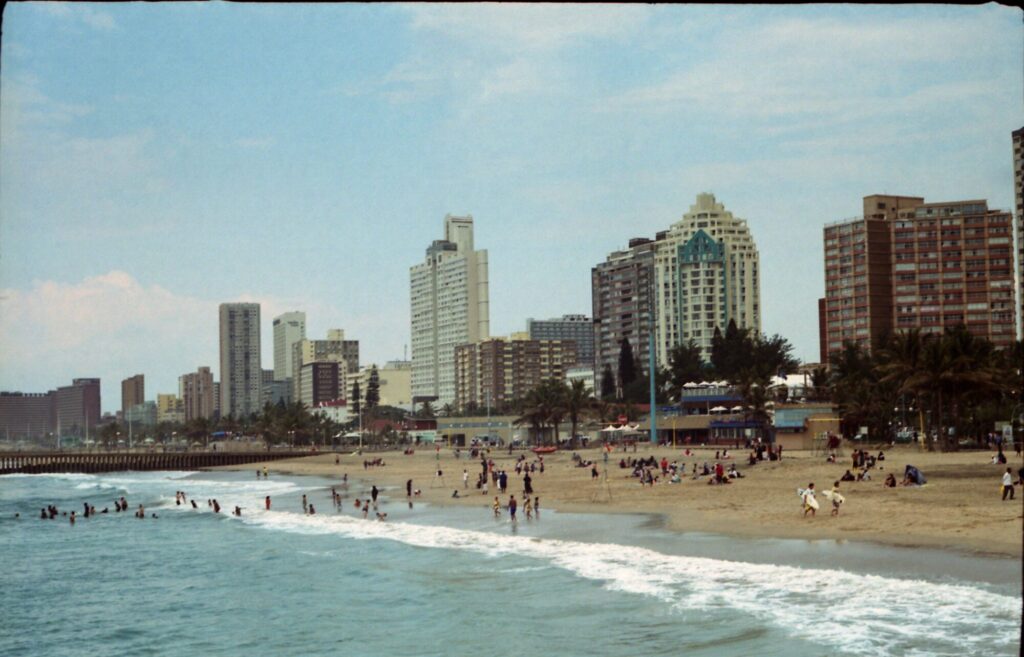
Durban is a working port city with a beach strip attached, not a resort town. Its reputation as a faded, unsafe beachfront is partly outdated — the eight-kilometre promenade is genuinely good and heavily used — and partly fair, because the city centre behind it is rough and the water infrastructure is fragile. Knowing which is which is most of what a visitor needs.
What Durban actually is
South Africa’s third-largest urban area and its main container port, on a warm subtropical Indian Ocean coast. The metropolitan municipality is called eThekwini; the city itself is still Durban.
Realistically, a visitor’s time is spent on the Golden Mile promenade, at uShaka Point, at Moses Mabhida, in the Berea, Morningside and Umhlanga suburbs, and on day trips. The central business district beyond the beachfront is not somewhere most visitors linger, and we are not going to pretend otherwise.
The climate is humid subtropical: about 1,009 mm of rain a year, February the warmest and wettest month at around 25.5 °C mean, July the coolest and driest at 17.4 °C. Sea temperatures run from 22 °C in winter to 26.5 °C in summer, which is why people swim here year-round.
What people do
- The Golden Mile promenade — eight kilometres from the harbour mouth to Blue Lagoon, the extension completed and opened on 16 November 2019, and wheelchair accessible. Walking or cycling it is the single best thing to do in Durban.
- uShaka Marine World, 1 King Shaka Avenue at the Point — Sea World aquarium, Wet ’n Wild, Dangerous Creatures and the Village Walk. Open daily 09:00 to 17:00. Note that uShaka sells tickets only at its own on-site ticketing office and warns about fraudulent third-party discount sites.
- Moses Mabhida Stadium, Stamford Hill — 56,000 seats, with guided stadium tours, Segway tours, People’s Park and a café.
- Victoria Street Market, Bertha Mkhize Street — Durban’s oldest market, over 200 vendors, spices, brassware, seafood and craft. Monday to Friday 08:00–17:00, Saturday 08:00–16:00, Sunday 09:00–15:00, with thirty minutes free parking on Fish Market Lane.
- Durban Botanic Gardens, Musgrave — Africa’s oldest surviving botanic garden, about 15 hectares, with a cycad collection built around Encephalartos woodii and over 9,000 orchids in the Ernest Thorp Orchid House. The Trust dates it to 1849; other sources say 1851. We could not load its current hours or entry fee.
- Swimming on the netted, lifeguarded central beaches — Addington, South Beach, North Beach, Bay of Plenty, Battery and uShaka.
- Umhlanga Rocks, north of the city, for the lighthouse, the pier and a calmer beachfront.
Beach water quality — the current position
This matters because a great deal of outdated reporting is still circulating. eThekwini Municipality publishes fortnightly E. coli results, and on the sheet dated 4 September 2026 every central Golden Mile beach was open for swimming, as were the northern beaches at Westbrook, Umdloti, Umhlanga Main and Bronze. On the southern beaches, one — Reunion — was closed. The municipality’s own bands are excellent below 130, acceptable 130 to 500, poor above 500.
So: as at early September 2026, one beach was closed, not the beachfront. Do not take the 2023–2025 mass-closure coverage as current. One caveat worth knowing: the city reports E. coli rather than Enterococci, which is generally regarded as the better indicator of sewage pollution, and it does not publish twelve-month averages.
Getting there
King Shaka International Airport (code DUR) at La Mercy opened on 1 May 2010, about 35 km north of the city and roughly 32 km or half an hour from the beachfront on the N2 and M4, tolled. It handled 5,616,199 passengers in the 2025–26 financial year and is South Africa’s third-busiest, with Emirates, Qatar Airways and Turkish Airlines among its international carriers.
By road: the N3 from Gauteng — Johannesburg to Durban is 571 km and about six hours, tolled — and the N2 along the coast. St Lucia is 238 km north, about two hours forty; Winterton, for the central Drakensberg, 215 km inland.
When to go
Winter, roughly May to August, is driest, sunniest and most comfortable for walking the city. December to March is hottest, most humid and wettest, but has the warmest sea. Mid-December to early January and Easter are South African domestic peak: the beachfront is genuinely crowded then.
Health and safety
No malaria. South African malaria is confined to northern and eastern Mpumalanga, northern KwaZulu-Natal and the northern border areas; the CDC names only uMkhanyakude District in this province, which is far up the coast. Durban cases that appear in surveillance data are imported, not local transmission. No prophylaxis is needed here.
Bilharzia is a fresh-water concern in KwaZulu-Natal, not a sea one. In the sea the real risk is surf and rip currents: the central beaches are netted and lifeguarded, and swimming outside those is unwise.
On crime, the honest position: South Africa has a high rate of violent crime, and standard advice is not to walk alone on deserted beaches or after dark, and to use arranged transport rather than minibus taxis. The city launched a coastal tourism policing initiative in May 2026 aimed specifically at the beachfront and tourism nodes, and says Metro Police now run daily enforcement operations there.
Practicalities
Fuel, banks, supermarkets and mobile coverage are normal metropolitan standard. Water supply is a real and current problem. The municipality and Umgeni-uThukela Water issued a joint statement in March 2026 about city-wide disruption caused by a control-valve failure on the aqueduct feeding Durban Heights, and the municipality’s notice archive carries repeated water-interruption notices across the city. It is worth asking accommodation whether it has tanks or a backup supply.
What to watch out for
- The city centre immediately inland of the beachfront is not a casual strolling area.
- Victoria Street Market sits at Warwick Junction, a transport interchange handling up to 460,000 people a day — busy, congested and pickpocket territory. Go by car or metered ride, in daylight.
- Moses Mabhida’s Adventure Walk (the arch climb) is currently unavailable; the stadium’s own page says it will return. The SkyCar and Big Swing are not listed on its current attractions page, so check before planning around them.
- The April 2022 KwaZulu-Natal floods killed at least 435 people and did about R17 billion of damage, including R5.7 billion to provincial roads, and broke two feeder lines to the Durban Heights reservoir. Visible damage on the main tourist routes has largely been repaired; the legacy a traveller actually notices is the fragility of the bulk water system.
Where to stay in Durban
Durban’s accommodation spans beachfront hotels on the Golden Mile, apartments at the Point and quieter guesthouses on the Berea ridge. Every property we list has been checked against its own official website.
Where to go next
- Umhlanga — the calmer beachfront just north
- St Lucia — 238 km north, the iSimangaliso gateway
- All of KwaZulu-Natal
What we do not publish. No nightly rates, no availability, no star ratings, no review scores. The beach water figures above come from eThekwini Municipality’s own published results, dated, rather than from news coverage; where a body does not publish something — the Botanic Gardens’ hours, for instance — we say so instead of guessing.
Chris Bloom from Durban, South Africa, CC BY-SA 2.0, via Wikimedia Commons